
Fire Safety
Interlinked Smoke & Heat AlarmsFor Glasgow Homes
Get a connected warning throughout your home without choosing alarm types and positions by trial and error. We survey the property, recommend a suitable arrangement and explain how to test and maintain it after installation.
Free, no-obligation site survey
FIA Registered
BAFE & SSAIB in progress
£10m Insured
Public & employers' liability
Up to 3-Year Warranty
When we install & maintain
24/7 Call-Outs
Day or night
Service overview
Understand the equipment and the work it needs
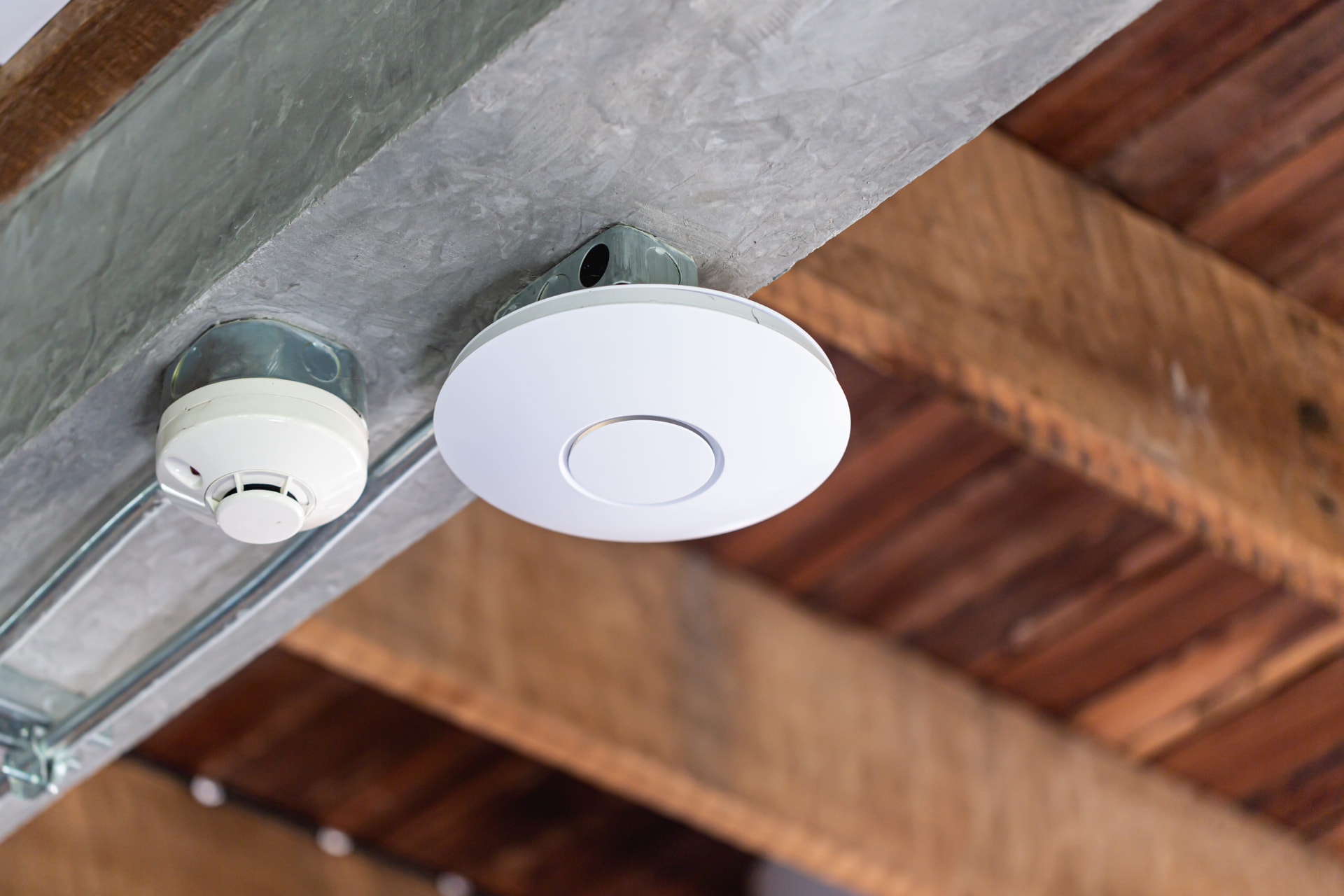
Interlinked smoke and heat alarms are connected so that when one detects its intended fire condition, the linked alarms sound together. This helps people elsewhere in the home hear a warning, rather than relying on a single alarm close to the fire. Smoke and heat devices perform different roles, so selecting the right type for each location matters.
This service is for homeowners, landlords and people improving fire detection during a move, refurbishment or change in household needs. It is also useful when existing alarms are unlinked, approaching their replacement date or causing repeated unwanted activations. The right arrangement depends on the layout and use of the property, not simply the number of rooms.
Professional installation considers location, compatibility, power arrangements and whether the warning can be heard where it is needed. Buying several alarms separately does not establish that they can communicate with one another or provide the intended coverage. H.E Fire & Security explains the proposed system and tests its operation, leaving you with clear instructions instead of a collection of unfamiliar devices.
The cost of waiting
Small warning signs can leave important protection uncertain
Equipment can remain in place for years while its condition, suitability or maintenance needs change. The important question is not simply whether it is present, but whether it remains appropriate for the premises and what evidence supports confidence in its operation.
An isolated alarm may not warn everyone
A detector sounding in one room may not provide a sufficient warning elsewhere. Interlinking helps spread the alarm signal, though audibility and individual household needs still require consideration.
The wrong detector can cause nuisance alarms
Smoke detectors placed where cooking fumes are expected can cause repeated unwanted activations. The device type and position should suit the location rather than encourage occupants to silence or remove it.
Incompatible products may not link
Similar-looking alarms are not necessarily designed to work together. Compatibility, product instructions and power arrangements need checking before relying on devices bought at different times or from different ranges.
Ageing alarms can be overlooked
A test button response does not cancel the manufacturer's replacement guidance. End-of-life signals, contamination and changing household needs should all prompt attention rather than waiting for a complete failure.
Common mistakes we see
- Assuming a heat alarm can replace the required smoke detection in every room or circulation space.
- Mixing alarm brands or ranges without confirming approved interlink compatibility.
- Removing a troublesome alarm instead of investigating its location, condition or cause of activation.
- Forgetting that carbon monoxide alarms detect a different hazard and do not replace fire alarms.
Our process
How We Deliver Interlinked Smoke & Heat Alarms
- 01
1. Survey the home and existing alarms
We review the layout, current devices and household needs during the free initial site survey. Tell us about extensions, fuel-burning appliances and any difficulty hearing existing alarms so relevant requirements can be considered.
- 02
2. Design the alarm arrangement
We recommend suitable smoke and heat alarm locations, interlink arrangements and power options. Product compatibility and manufacturer guidance inform the design, along with the Scottish requirements and guidance applicable to the property.
- 03
3. Install the agreed equipment
Alarms are fitted in the agreed positions using an appropriate method for the selected equipment. Wired work and access requirements are discussed in advance; radio interlinking does not mean every type of alarm can be installed without electrical work.
- 04
4. Test detection signals and interlinking
We check the installed system using appropriate test procedures and verify that linked alarms respond as intended. Any relevant limitations or additional household needs are discussed rather than assuming standard audible alarms suit every occupant.
- 05
5. Hand over testing guidance and warranty
We explain routine checks, end-of-life indications and the installed product instructions. New installations have a one-year warranty, extended to three years on systems installed and maintained by H.E Fire & Security; agreed cover is explained at handover.
What you get
The Benefits, in Plain Terms
Simplify the installation decision
A property-specific recommendation removes the need to compare unfamiliar product ranges and guess which devices should go in each location.
Spread the warning through the home
Interlinking allows a detected fire condition to trigger connected alarms, helping occupants beyond the room of origin receive an earlier warning.
Plan replacement before failure
Clear product information and maintenance guidance help you track alarm age and recognise when devices are approaching their intended replacement point.
Avoid incompatible purchases
Choosing a coordinated system helps prevent spending on separate devices that cannot interlink or are unsuitable for the intended location.
Check the system works together
Commissioning tests confirm the intended linked response at installation, rather than relying only on each alarm making a sound independently.
Know how to look after it
A practical handover gives you straightforward testing instructions and a contact for faults, making ongoing responsibility less confusing after the installation is complete.
In depth
Interlinked Smoke & Heat Alarms explained for local properties
Related services
Scottish interlinked alarm requirements
Since February 2022, Scottish homes have been required to meet the interlinked fire alarm standard. The general arrangement includes a smoke alarm in the room used most frequently for daytime living, a smoke alarm in every circulation space on each storey, such as halls and landings, and a heat alarm in each kitchen. These fire alarms should be ceiling mounted and interlinked.
This describes the general minimum arrangement, not a complete design for every dwelling. Unusual layouts, work covered by building standards or particular occupancy needs may call for further consideration. Tell us about loft conversions, extensions and changes in room use so the proposed installation addresses the property as it actually stands.
Mains-powered and sealed-battery alarm options
Suitable mains-powered alarms with battery backup and suitable tamper-proof long-life battery alarms can meet the Scottish standard when selected and installed correctly. Radio interlinking can connect compatible devices without a physical interlink cable between each alarm. The appropriate approach depends on the property, existing wiring and the selected product system.
Mains power does not remove the need to consider backup arrangements or manufacturer replacement dates. Likewise, a sealed battery is not a promise that a device will last indefinitely. We explain how the chosen equipment is powered, how it signals faults and what you should do when it reaches the end of its intended life.
Smoke alarms, heat alarms and carbon monoxide
Smoke alarms respond to smoke particles, while heat alarms respond to temperature conditions. Kitchens generally need heat alarms under the Scottish standard because normal cooking can cause unwanted smoke alarm activations. Selecting a heat alarm for a kitchen does not make it an interchangeable substitute for the smoke alarms needed elsewhere.
Carbon monoxide is a separate hazard. Scottish guidance also requires carbon monoxide detection in relevant circumstances involving carbon-fuelled appliances or flues; gas cookers and hobs alone are excluded from that particular requirement. Carbon monoxide alarms do not generally need to interlink with the fire alarms. Placement must follow the applicable requirements and product instructions.
BS 5839-6 and household needs
BS 5839-6 provides recommendations for fire detection and alarm systems in domestic premises. The appropriate grade and coverage depend on the setting and relevant requirements; the Scottish minimum should not be presented as the only consideration for every type of accommodation. A rented property or more complex dwelling may need a more detailed review.
Consider the occupants as well as the floor plan. Standard audible alarms may not adequately warn someone with hearing loss, and specialist alerting equipment may be needed. Tell us about those requirements during the survey so the proposal can address them. Installing more ordinary sounders is not automatically the right answer to every accessibility need.
Interlinked Smoke & Heat Alarms Across Central Scotland
FAQ
Interlinked Smoke & Heat Alarms Questions
We offer a free initial site survey and quote per project. The price depends on the premises, equipment, access and agreed scope of work. There are no fixed package prices to assume before the system or property has been reviewed. Any additional recommended work is explained so you can make an informed decision.
Free site survey · No obligation
Make your next maintenance or installation decision clearer
Call 07380 866221 to arrange a free initial site survey. H.E Fire & Security will discuss your premises, explain the proposed scope and provide a project-specific quote without fixed-price assumptions.
4 engineers · FIA registered · £10m insured