Fire Safety
Fire Extinguishers in GlasgowFor Central Scotland Properties
Equip your premises for appropriate first-aid firefighting without guessing which extinguisher belongs where. We assess the hazards, recommend suitable provision and explain the completed layout, with a free initial survey and a clear project-specific quotation.
Free, no-obligation site survey
FIA Registered
BAFE & SSAIB in progress
£10m Insured
Public & employers' liability
Up to 3-Year Warranty
When we install & maintain
24/7 Call-Outs
Day or night
Service overview
Put suitable extinguishers where people can find them
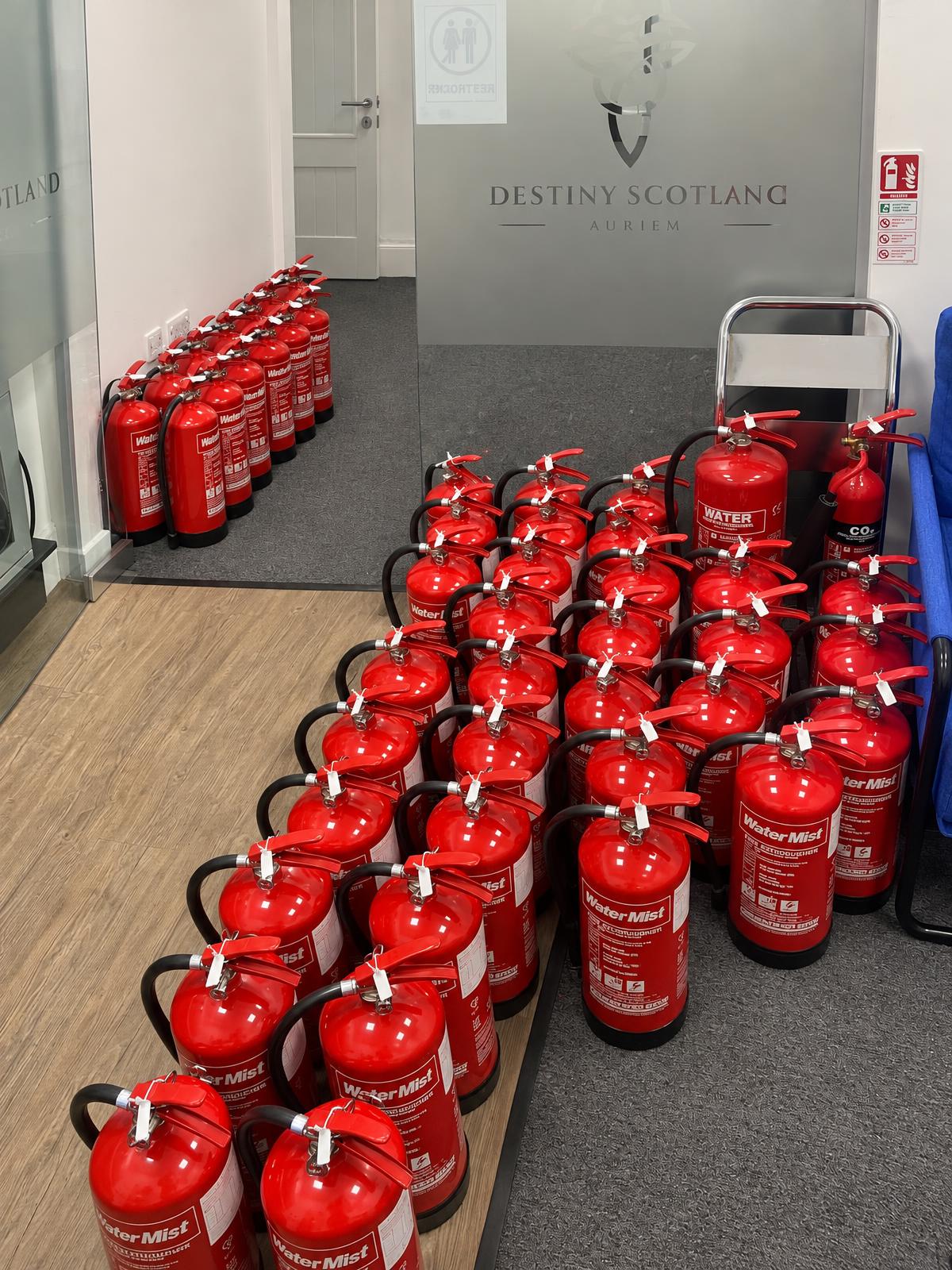
Portable fire extinguishers provide a means of tackling a small fire where it is safe, the equipment is suitable and the user knows what to do. They are not a replacement for raising the alarm, maintaining an escape route or evacuating. H.E Fire & Security supplies and installs extinguishers for domestic, commercial and industrial properties across Glasgow and Central Scotland.
New premises, changes of use, kitchen alterations or new equipment can all change the required provision. Business owners, landlords and property managers may also need to replace damaged or unsuitable units identified during a review. Choosing by the colour of a label alone misses important questions about fire class, rating, position and the people expected to use the equipment.
A professional assessment considers the actual hazards and the wider fire safety arrangements. We explain suitable options, practical mounting positions and the need for ongoing inspection and servicing. Our Kilsyth-based team of four engineers and two admin staff helps organise the work around access and occupancy, so extinguishers are supplied as a coherent provision rather than a collection of unrelated purchases.
The cost of waiting
When fire extinguishers do not match the risk
The wrong extinguisher can make an incident more dangerous, while the right unit is of limited use if it is blocked, damaged or positioned where people cannot reach it safely. Effective provision starts with hazards and escape arrangements, then considers equipment selection, visibility and a maintenance plan.
Unsuitable extinguishing agent
Different fires require different approaches. Using an unsuitable extinguisher on live electrical equipment or burning cooking oil can create serious additional danger rather than controlling the incident.
Equipment out of reach
Units hidden behind stock, furniture or locked doors may not be available when needed. Locations should remain visible and accessible as the premises changes.
Unnoticed deterioration
Damage, corrosion, discharge or loss of pressure may leave an extinguisher unfit for use. An intact-looking outer casing alone does not establish that it is ready.
Unsafe attempts to fight fire
Extinguishers can create false confidence if people do not understand their limits. Life safety, raising the alarm and maintaining an escape route must remain the priority.
Common mistakes we see
- Ordering identical extinguishers for every area without reviewing the different fire hazards.
- Moving units during refurbishment without checking whether the new positions remain suitable.
- Assuming an unused extinguisher never needs professional servicing or replacement.
- Treating the presence of extinguishers as a reason to delay evacuation or call for help.
Our process
How We Deliver Fire Extinguishers
- 01
Survey hazards and existing provision
We review the building use, likely fire classes, existing equipment and available fire risk information. Kitchens, electrical equipment, storage and access arrangements help establish the selection and positioning decisions that need to be made.
- 02
Specify suitable equipment
We recommend extinguisher types, ratings and locations for the agreed scope. Your project quotation explains the proposed provision, including replacement or additional units where needed, without relying on a fixed package for every premises.
- 03
Supply and position the units
We install the agreed equipment in suitable locations, with appropriate mounting and identification arrangements. Access is coordinated with your operations so the completed layout is practical for occupants and does not obstruct routes.
- 04
Check provision and accessibility
We check the supplied units, locations and relevant commissioning details. The completed arrangement is reviewed against the agreed specification, and any limitations or actions outside the installation scope are explained rather than left unclear.
- 05
Handover and plan ongoing care
We explain the installed provision, routine visual checks and servicing requirements. New installs have a one-year warranty; three years applies to systems installed and maintained by H.E Fire & Security, with applicability confirmed in your quotation.
What you get
The Benefits, in Plain Terms
Faster access to suitable equipment
Clear positioning and appropriate identification help people locate the relevant extinguisher without searching through cupboards or moving stored items during an emergency.
Safer equipment selection
Matching the agent and rating to assessed hazards reduces the risk of relying on a unit that is unsuitable for the fire involved.
Equipment kept fit for use
Accessible mounting and a planned servicing approach support inspection, identify deterioration and help avoid damaged units remaining unnoticed in the building.
Less unnecessary replacement
Reviewing existing units and current hazards helps distinguish equipment that remains suitable from units needing replacement, rather than purchasing an arbitrary matching set.
More reliable ongoing provision
Documented locations and clear responsibilities make it easier to spot missing, moved or discharged extinguishers before a later incident exposes the gap.
A clearer fire safety plan
Understanding what extinguishers can and cannot do helps those responsible for the premises keep equipment provision in perspective alongside evacuation, training and other precautions.
In depth
Planning fire extinguishers around your building
Related services
Water, foam, powder, CO2 and wet chemical options
Water-based extinguishers are commonly used for suitable Class A materials such as wood, paper and textiles, subject to the equipment's rating and instructions. Foam options may cover particular solid and flammable liquid hazards. The exact application depends on the product, and selection should consider current suitability and any applicable environmental restrictions rather than relying on a generic label.
CO2 units are commonly considered around electrical equipment, but have limitations and do not suit every location. Wet chemical extinguishers are commonly used for appropriate cooking oil and fat hazards. Powder has particular applications but can affect visibility, breathing and equipment, making it unsuitable as a casual default for occupied indoor areas.
Fire classes, ratings and special hazards
Class A, B, C, D and F describe different fire types, including solid materials, flammable liquids, gases, metals and cooking oils or fats. Electrical equipment is not a separate UK fire class. Where electricity is involved, the selected equipment and safe approach must account for the electrical hazard as well as the burning material.
Specialist processes, combustible metals and unusual stored substances need a specific assessment. Lithium-ion battery incidents also require careful planning and should not be reduced to a claim that one ordinary extinguisher solves every battery fire. Tell us about actual materials and processes so any need for specialist advice can be identified before equipment is specified.
Positioning, signage and day-to-day checks
Extinguishers are generally positioned to support safe access, often near suitable exit routes or specific hazards, with placement determined by the premises and relevant recommendations. They should not create an obstruction or encourage someone to move deeper into danger. Mounting, visibility and identification all affect how usable the provision will be.
Responsible staff should understand the routine visual checks appropriate to the premises and report missing units, damage or discharge promptly. Stock deliveries, new furniture and refurbishment can all interfere with access. Keep the locations under review and do not relocate equipment merely to make a display or storage area look tidier.
BS 5306 recommendations and Scottish fire duties
BS 5306-8 addresses the selection and positioning of portable fire extinguishers, while BS 5306-3 addresses commissioning and maintenance. The relevant recommendations should inform provision alongside the fire risk assessment and any specific hazards. A service label alone does not show that the number, type and locations remain suitable after a business changes its activities.
The Fire (Scotland) Act 2005 forms part of the framework for duties in relevant premises. Providing extinguishers is one element of managing fire risks, not a stand-alone compliance guarantee. H.E Fire & Security is a registered member of the FIA, with BAFE and SSAIB accreditation in progress; we do not describe those accreditations as already held.
Domestic settings, workplaces and safe use
A household may need different advice from a commercial kitchen or industrial workshop. The hazards, occupants and available escape routes all matter. In a home, the emphasis remains on warning, getting out and calling the emergency services; the presence of an extinguisher must never encourage someone to take risks they would otherwise avoid.
In workplaces, those responsible should consider appropriate instruction and training alongside equipment provision. Anyone faced with smoke, rapid fire growth or an uncertain situation should prioritise escape. After an extinguisher has been used, even briefly, arrange assessment rather than returning it to its place and assuming there is sufficient agent left for another incident.
Fire Extinguishers Across Central Scotland
FAQ
Fire Extinguishers Questions
We offer a free initial site survey and quote each project individually. For fire extinguishers, the quotation depends on the property layout, equipment requirements, existing installation, access and the agreed scope. We explain the proposed work before you decide, rather than giving a fixed price that may not reflect your building. Let us know about any drawings, insurer conditions or planned alterations before the survey.
Free site survey · No obligation
Put suitable extinguishers where people can find them
Book a free initial site survey with our Kilsyth team. We will explain the practical options and quote for your project before you commit. Call 07380 866221 to discuss fire extinguishers in Glasgow or Central Scotland.
4 engineers · FIA registered · £10m insured